Grout Cleaning Tool
InquiryNotched-blade grout cleaner with replaceable blade — opens and cleans joints in tile, cement and masonry, stripping grout, silicone and residue quickly and cleanly.
Specifications
| Specifications | Qty/ctn |
|---|---|
| 210mm | 200PCS |
| Material | Notched alloy steel blade + nylon |
| MOQ | 10 cartons |
| Handle | Nylon |
| Surface treatment | — |
| OEM custom | 50+ cartons — custom packing & logo |
| Packing | Export carton (polybag / color box / blister available per request) |
Specifications and packing quantities are for reference only. Actual packing quantities may vary slightly depending on the box condition, and can also be customized according to your requirements.
← Back to Building & Finishing Tools · Download 2026 Catalog (PDF)
Where a grout cleaner earns its keep
Re-grouting starts with removal: the old grout has to come out of the joint without chipping the tile edge. The angled blade on this tool follows the joint line and clears grout, silicone and cured residue — the slowest job in any bathroom or kitchen refresh, made fast.
Beyond tile joints, the same blade works cement, brick and masonry joints — old grout out of brick gaps, or a fresh joint opened to width. It also handles old caulk along countertops and window frames, and adhesive residue after floor demolition — one tool that keeps working between the messy stages of a renovation.
Why a notched blade and nylon
The blade carries a notched, saw-style edge: it bites into cured grout and silicone instead of skating over it, clearing a standard joint in one pass. Hard cement is where the chipped-grain design earns its keep — the edge tears into what a plain blade skates over. Alloy steel holds that edge through wall after wall, wear-resistant where a plain blade dulls. The nylon body protects the tile: no metal-on-ceramic contact on the surfaces you want to keep.
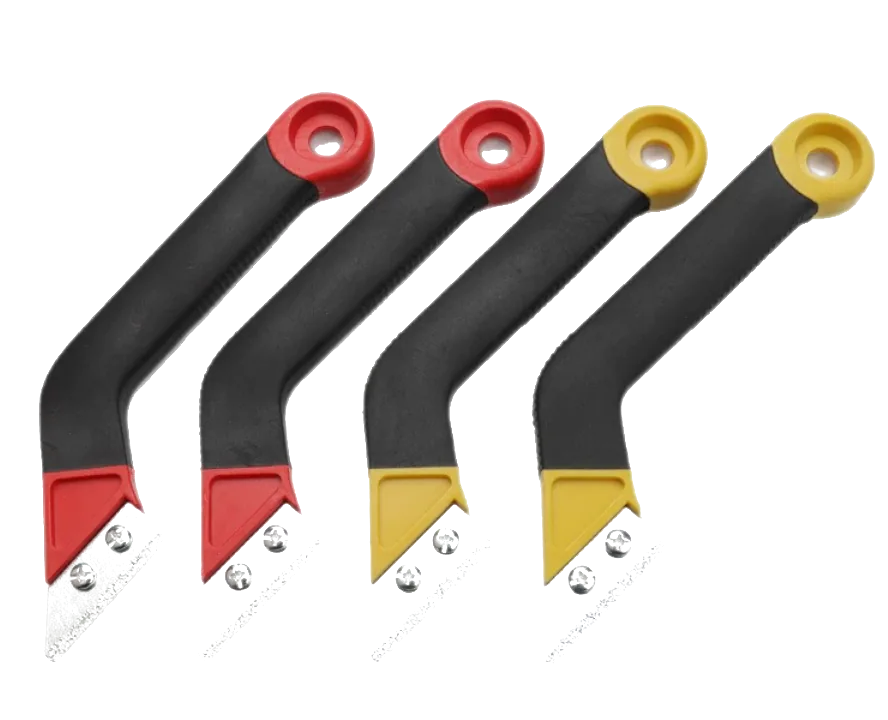
The handle is built for long shifts: colored plastic (red or yellow) over a black soft grip, with a hanging hole for storage between jobs. Two screws fix the blade, so it swaps without tools — the handle survives the whole job instead of the first wall, and trade buyers reorder blades rather than whole tools. For the crew, that is the difference between a day of scraping and an afternoon: less time per joint, less force per stroke.
Grout Cleaning Tool — FAQ
What is it used for?
Clearing old grout out of tile, brick, cement and masonry joints before re-grouting — and opening or widening a joint to width when the job calls for it.
What is it made of?
A notched alloy-steel blade with a nylon handle.
What is the MOQ?
10 cartons; private-label packing and logo from 50+ cartons.
Is the blade replaceable?
Yes — the blade swaps with two screws, so the handle stays in cycle job after job. When the edge finally dulls, reorder blades instead of whole tools.
Is it easy to operate?
Yes — the angled blade follows the joint line in one hand. No power, no setup, no measuring: line it up and push.
Will it mark glazed tile?
The notched alloy blade and nylon body are designed to clean joints without marking glazed surfaces.
What other cleanup does it handle?
Old silicone, caulk and adhesive residue on tile, stone and countertop edges.
Does it work on cement joints?
Yes — tile, cement and other masonry. The notched edge cleans out old grout and opens fresh joints in both.
What does the handle look like?
Two-tone: colored plastic (red or yellow) with a black soft grip and a hanging hole. The blade is fixed with two screws, so it swaps without tools.